How to Choose an INOFLAR® PVDF Grade: Pellets or Powders?
The INOFLAR® PVDF lineup has 16 grades. That sounds like a lot to sort through, but two questions narrow it quickly: how will you process the resin, and what are you making? This guide gives you a first-pass short list to bring to GFL Americas before you request samples.
Question 1: How will you process it?
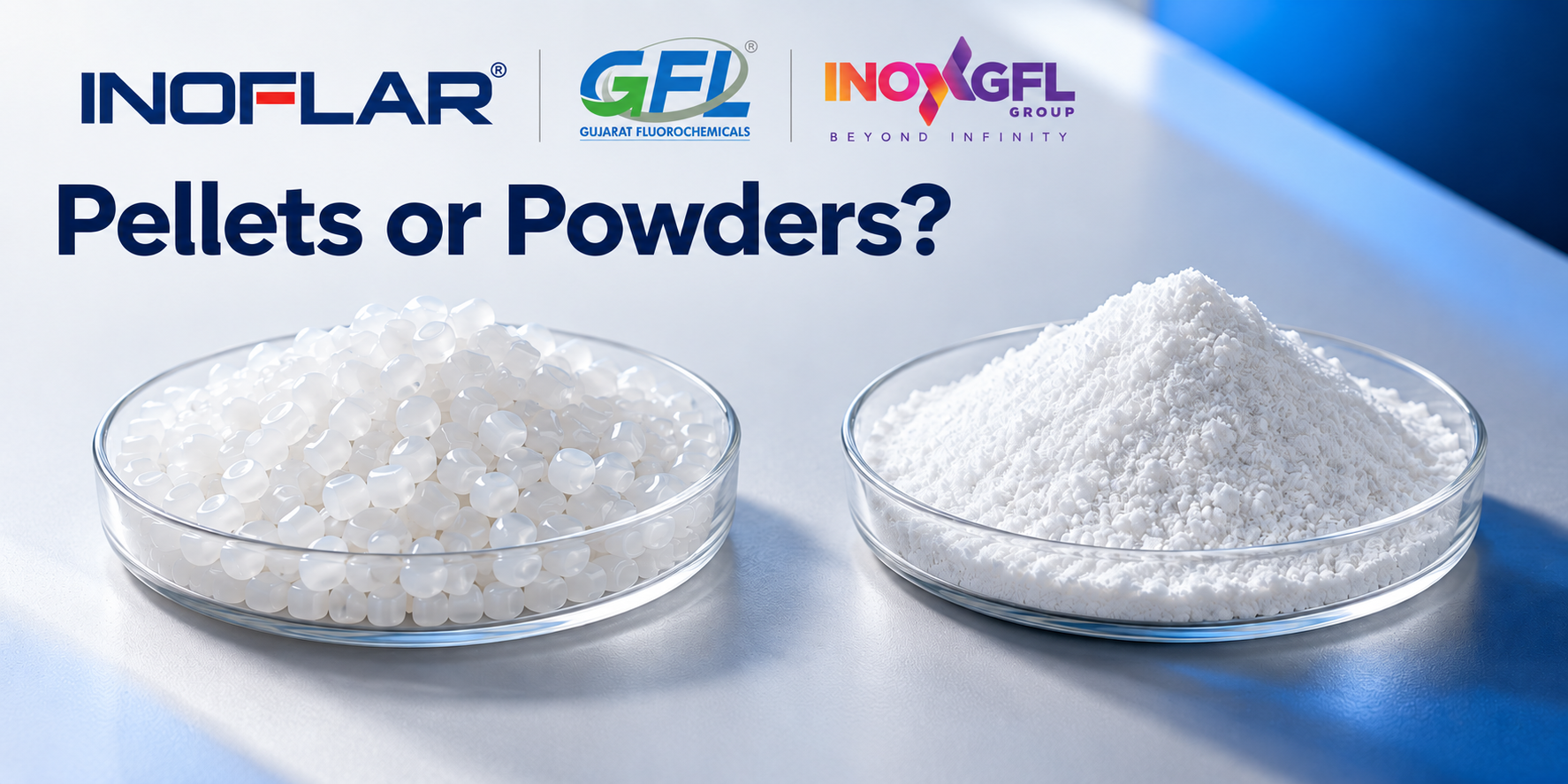
The first split is by form. INOFLAR® PVDF comes as pellets or as powders, and the two are processed in very different ways.
Pellets are melt-processed.
INOFLAR® pellet grades are melt-processable PVDF resins, processed using conventional polymer equipment. They are used to manufacture "pipes, fittings, pumps, and valves, as well as sheets for vessel and tank linings, tower packing, filaments, and films."
Powders are solvent-soluble.
INOFLAR® PVDF powders are soluble in polar solvents such as NMP. The higher surface area-to-volume ratio aids easier and faster dissolution. That makes them the starting point for solution-based processes such as membrane casting and coatings.
- Active solvents (≈5–10% w/w @ 25°C): N-methylpyrrolidone (NMP), dimethylacetamide (DMAC), dimethylformamide (DMF), tetramethyl urea, dimethyl sulfoxide (DMSO), trimethyl phosphate
- Latent solvents (<1% w/w @ 25°C): acetone, tetrahydrofuran, methyl ethyl ketone
If your process melts the resin, start with pellets. If it works from a solution, start with powders.
Question 2: Homopolymer or copolymer?
The portfolio includes homopolymer and PVDF-HFP copolymer grades. Select the grade that matches your processing method and component requirements. The tables below show how GFL lists each one.
| Grade | Type | Processing | Typical applications / technical details |
|---|---|---|---|
| INOFLAR® 1005 | Homopolymer | Injection molding | Lower melt viscosity |
| INOFLAR® 1011 | Homopolymer | Injection molding | Lower melt viscosity |
| INOFLAR® 1017 | Homopolymer | Extrusion (also injection molding) | Request grade details |
| INOFLAR® 1020 | Homopolymer | Extrusion (also injection molding) | Request grade details |
| INOFLAR® 2010 | PVDF copolymer | Injection molding, transfer molding, extrusion | Lined components, tubes, wire insulation, cable jacketing, films |
| INOFLAR® 2020 | PVDF copolymer | Extrusion, compression molding | Sheets and flexible tubes |
| INOFLAR® 2010 FP75 | PVDF copolymer | Request grade details | Wire & cable; chemical processing |
| Grade | Type | Typical applications / technical details |
|---|---|---|
| INOFLAR® 1125 | Homopolymer | Flat-sheet membranes |
| INOFLAR® 1135 | Homopolymer | Hollow fiber and tubular membranes |
| INOFLAR® 5125 | Homopolymer | Coating |
| INOFLAR® 2110 | PVDF copolymer | Wire & cable; chemical processing |
| INOFLAR® 2120 | PVDF copolymer | Wire & cable; chemical processing |
| INOFLAR® 2125 | PVDF copolymer | Request grade details |
| INOFLAR® 2140 | PVDF copolymer | Wire & cable; chemical processing |
Two further powder grades, INOFLAR® 1150 and 3160, serve specialist applications. Contact GFL Americas for details.
Where to start, by application
- Injection-molded components: INOFLAR® 1005 or 1011, the injection molding grades with lower melt viscosity.
- Extruded profiles and piping-system components: INOFLAR® 1017 or 1020, preferred for extrusion and also suitable for injection molding.
- Lined components, tubes, films, wire insulation and cable jacketing: INOFLAR® 2010.
- Sheets and flexible tubes: INOFLAR® 2020.
- Flat-sheet membranes: INOFLAR® 1125.
- Hollow fiber and tubular membranes: INOFLAR® 1135.
- Coatings: INOFLAR® 5125.
- Wire & cable and chemical processing: copolymer pellets (INOFLAR® 2010 FP75) or copolymer powders (INOFLAR® 2110, 2120, 2140). Ask GFL Americas which fits your process.
Treat this as a starting point. Final selection depends on your operating conditions and part design, and should be confirmed against the current datasheet with GFL Americas technical support.
INOFLAR® PVDF at a glance
- Broad chemical resistance from pH 0–14 and continuous service to 150°C.
- INOFLAR® PVDF resins are manufactured without the use of fluoro-surfactants.
- U.S.-Stocked Samples. Delivered in 3–5 Business Days. (Delivery within the continental United States.)
Questions to bring to your next PVDF evaluation
Use this checklist with any supplier:
- Which chemicals, concentrations and temperatures will the part see in service, including cleaning cycles?
- Is the resin melt-processed or solution-processed in your operation, and with which solvent system?
- Which processing method and equipment will you use, and at what wall thickness or film gauge?
- Which regulatory or compliance documents does your application require, and for which specific grade?
- What qualification testing will you run, and how many samples do you need for it?
- How quickly do you need samples, and to which location?
Next step
Have a short list? Request a sample. INOFLAR® PVDF samples are stocked in the U.S. and delivered in 3–5 business days within the continental United States. Tell us your application and process, and we will help you confirm the right grade.
The GFL Americas Team
Information is general and for evaluation purposes. Material suitability depends on specific conditions; confirm with current datasheets and GFL Americas technical support. Not a warranty or specification.
INOFLAR® is a trademark of Gujarat Fluorochemicals Limited.
By The GFL Americas Team